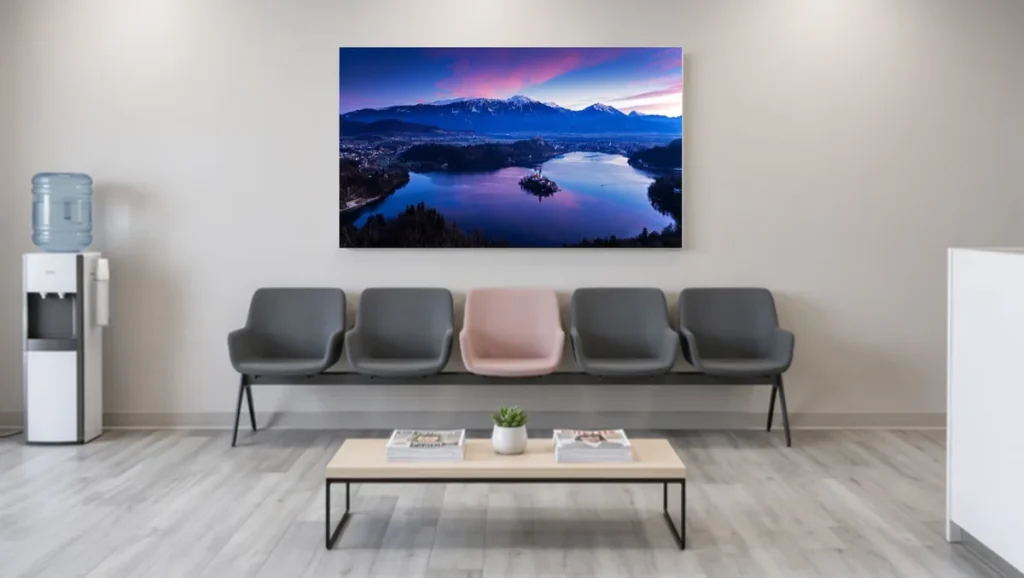
The best art for a waiting room is a calm landscape: still water, open space and soft light, printed large enough to see clearly from the chairs. For most practices that means a matching set of two to four prints rather than one small picture on each wall.
I’m a landscape photographer and I sell my photos as fine art prints. Many of them are lakes at dawn, misty mornings, mountains in snow and quiet beaches, which suits the rooms where people sit and wait at dental surgeries, physiotherapy practices, private clinics and vets. This guide covers which subjects help people relax, which to avoid, what sizes to choose for a row of prints, and how to order several that match.
What makes good art for a waiting room?
Good art for a waiting room shows still or gently moving water, an open view with distance in it and soft light, in a scene people can read at a glance. These are the subjects hospital art committees choose, following guidelines based on the work of the healthcare design researcher Roger Ulrich (Ulrich and Gilpin, 2003).
The subjects they recommend, as listed in UConn Health’s artwork guidelines:
- calm water, gently flowing rivers and waterfalls
- landscapes with an open foreground, low hills and distant mountains
- warm seasons, green vegetation and fresh flowers
- birds and other non-threatening wildlife
- people at leisure in natural settings
Research in waiting rooms points the same way, though the effects are small. A 1990 study by Heerwagen found that dental patients had lower heart rates on days when a landscape mural hung in the waiting room (Law et al., Frontiers in Psychology, 2020). A field study in a hospital waiting room found that real plants or posters of plants slightly reduced patients’ stress, partly because the room looked more attractive. Not every study finds an effect, so treat pictures as one part of a calm room, along with short waits and friendly staff.
Many of my prints are of places I keep going back to: Lake Bled and Lake Bohinj in Slovenia, where I spend much of my time, and the Dorset coast. A lot of them were taken at dawn on still mornings, which puts much of my catalogue on that list.
Which pictures should you avoid in a waiting room?
Avoid anything that could look like a threat, or that a nervous person could read in more than one way. The same guidelines list ambiguous images, emotionally negative subjects, surreal or optical-illusion art, cramped images with no depth, dangerous animals or animals staring straight at the viewer, overcast or foreboding weather, and bleak or turbulent landscapes.
Plenty of good photos fail that test, including some of mine. These are the ones I’d keep for homes rather than waiting rooms:
- Storms and rain. Moody Lake Bled at Sunset and Storm Clouds at Sunrise over Swanage both show bad weather closing in.
- Big seas. My Portland Bill photos show waves crashing over the rocks. They suit a sailing club better than a room of people waiting for a filling.
- Large wild animals. I photograph brown bears in the forests of southern Slovenia. People like them, but a bear is a large predator, which is what the guidelines warn against.
- Folklore and dark history. I write about legends and have photographed places like Combe Gibbet on Gallows Down. Nobody needs to look at a gibbet before an injection.
- Bleak winter scenes. A snowy lake under a blue sky can work. Grey skies, bare branches and heavy black and white images look cold and empty. The guidelines favour colour scenes from the warmer months, so for a waiting room I’d choose colour over black and white.
If you’re unsure about a picture, ask whether a nervous patient could read anything worrying into it. If they could, choose another.
What art suits dentists, physios, private clinics and vets?
The same rules apply to every practice, but each type of waiting room has its own needs.
Dental surgeries
Dental waiting rooms hold some of the most anxious patients, so choose the calmest subjects: still water, mist, sunrise and wide skies. Lake scenes such as sunrise over Lake Bled from Mala Osojnica or the Church of Saint John at sunrise on Lake Bohinj suit this best. In treatment rooms, a single print on the wall the patient faces from the chair gives them something to look at other than the instruments.
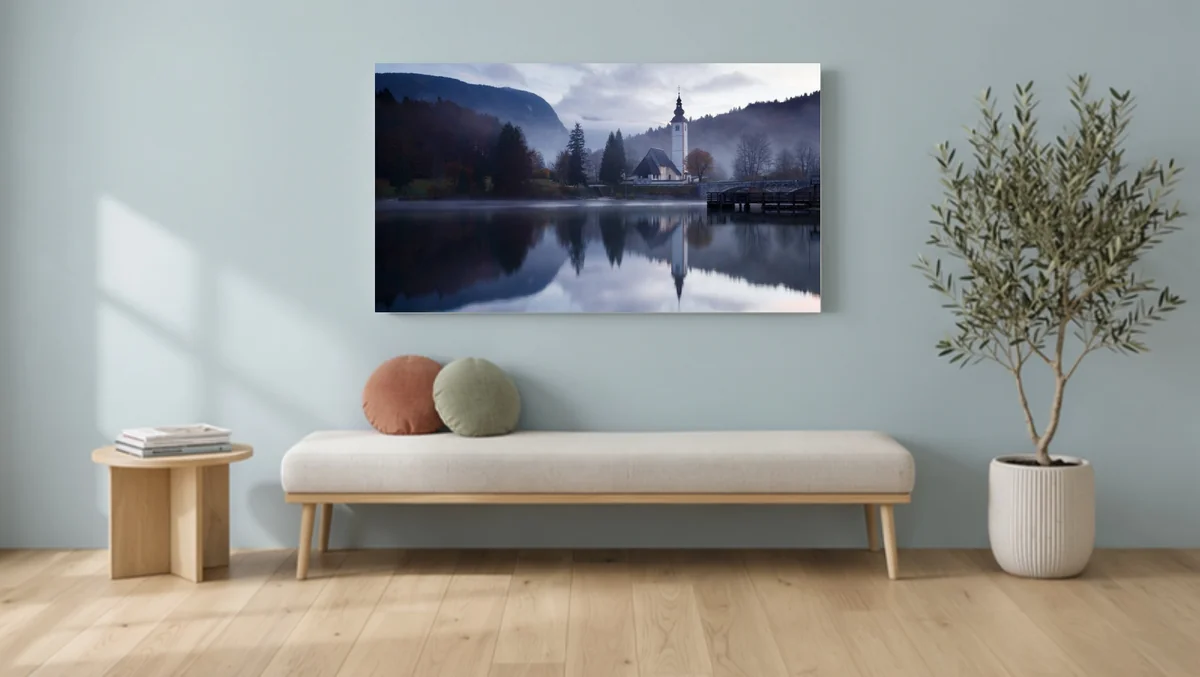
Church of Saint John at sunrise, Lake Bohinj
Physiotherapy practices
Physio patients often come back every week for a course of treatment, so they see the same walls many times. A set from one place in different seasons gives repeat visitors something new to notice, such as Lake Bled in early spring, summer and autumn. Many patients are working towards walking, running or climbing again, so open mountain views and coast paths fit the room.
Private clinics and consulting rooms
Private clinics often want reception to feel more like a hotel than a hospital. A single large panorama behind the reception desk, with smaller matching prints in the consulting rooms and corridor, gives the practice one consistent look. Choose colours that sit with your decor: the blues and greens of the lakes, warm sunrise tones or the purple of the Hampshire lavender fields.
Veterinary practices
A vet’s waiting room is busy and noisy, and the owners are often as anxious as their animals. Coast and countryside scenes, the kind of places people walk their dogs, sit well here. Hang prints with the bottom edge above the reach of a dog on its hind legs and the swing of a pet carrier, and choose canvas or metal rather than a print framed under glass.
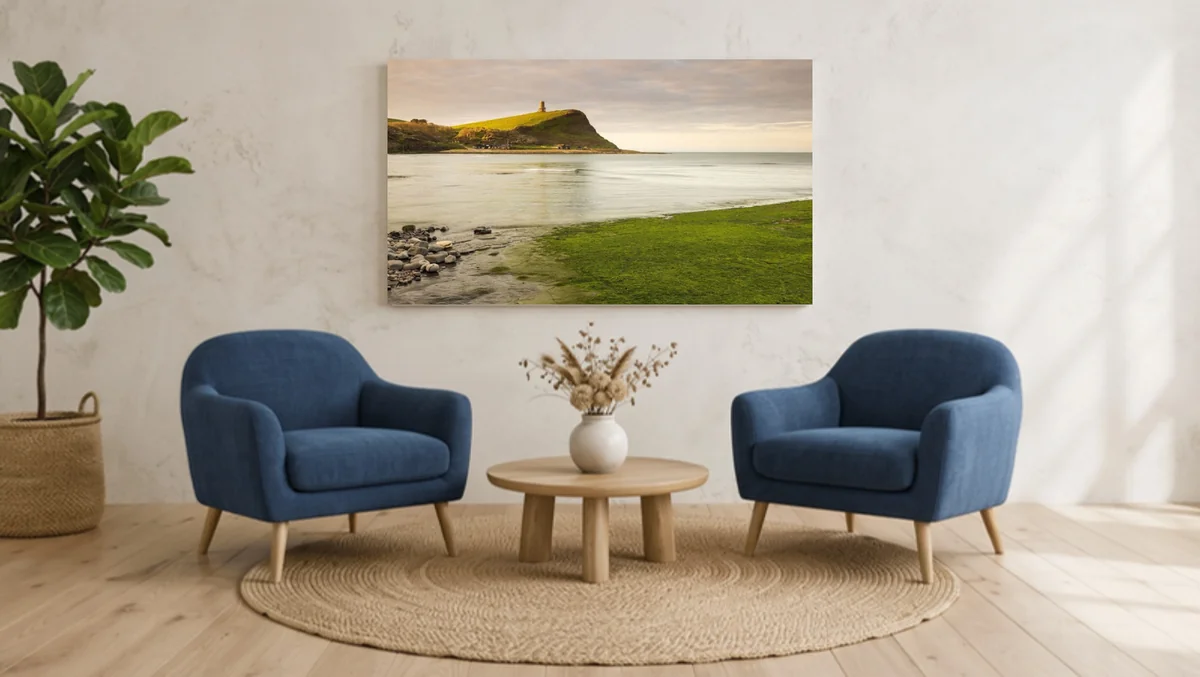
Morning at Kimmeridge Bay, Jurassic Coast, Dorset
What size prints should you choose for a waiting room?
For the main wall of a waiting room, start with 90cm prints. People see them from the far side of the room, often 3–4 metres away, and a 45cm print looks small from there. Keep 45cm and 30cm prints for consulting rooms, corridors and narrow walls that people see close up.
On my website, paper and canvas prints come in four sizes, measured along the longest side. Other sizes are available through the Fine Art America link on each product page. The short side depends on the shape of the photo, so check the product page if you need the exact measurement. Paper sizes include the 1″ white border.
Size
Approx. landscape
Where it works
Some panoramas come larger still. Lake Jasna in spring goes up to a 200cm paper print or a 180cm canvas, which suits the wall behind a long reception desk.
How to size a row of prints
A row of prints, including the gaps between them, should cover about two-thirds to three-quarters of the wall or the row of seats beneath it. To work out the width of a row, add the widths of the prints to the widths of the gaps.
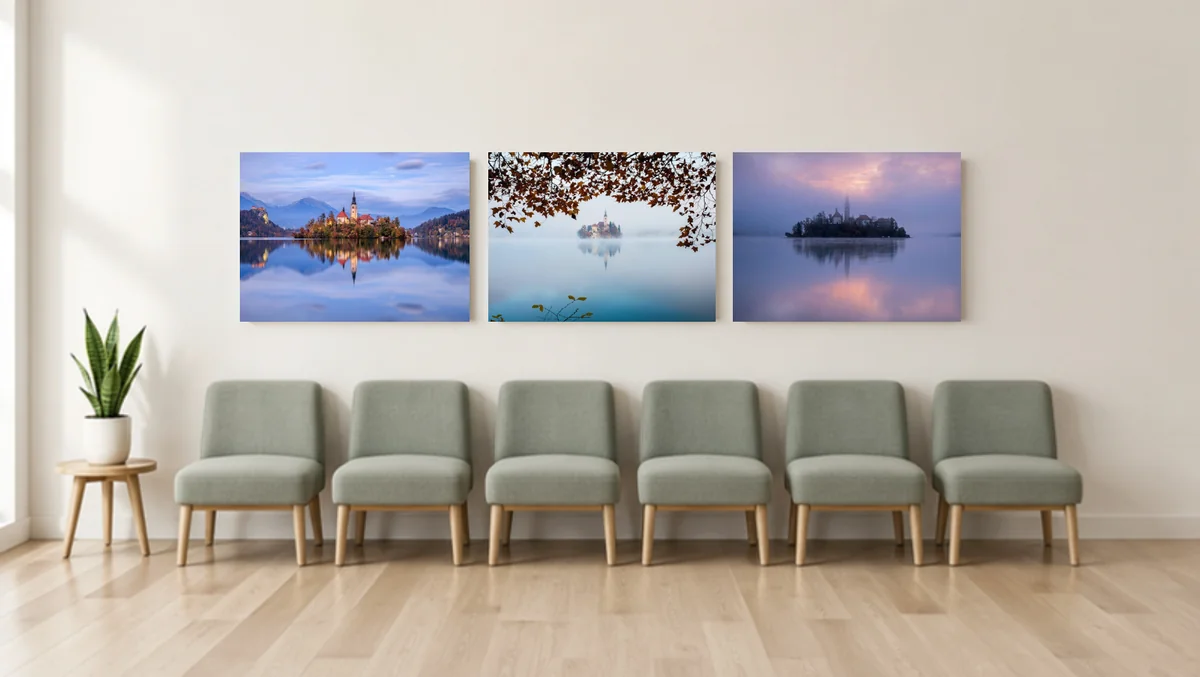
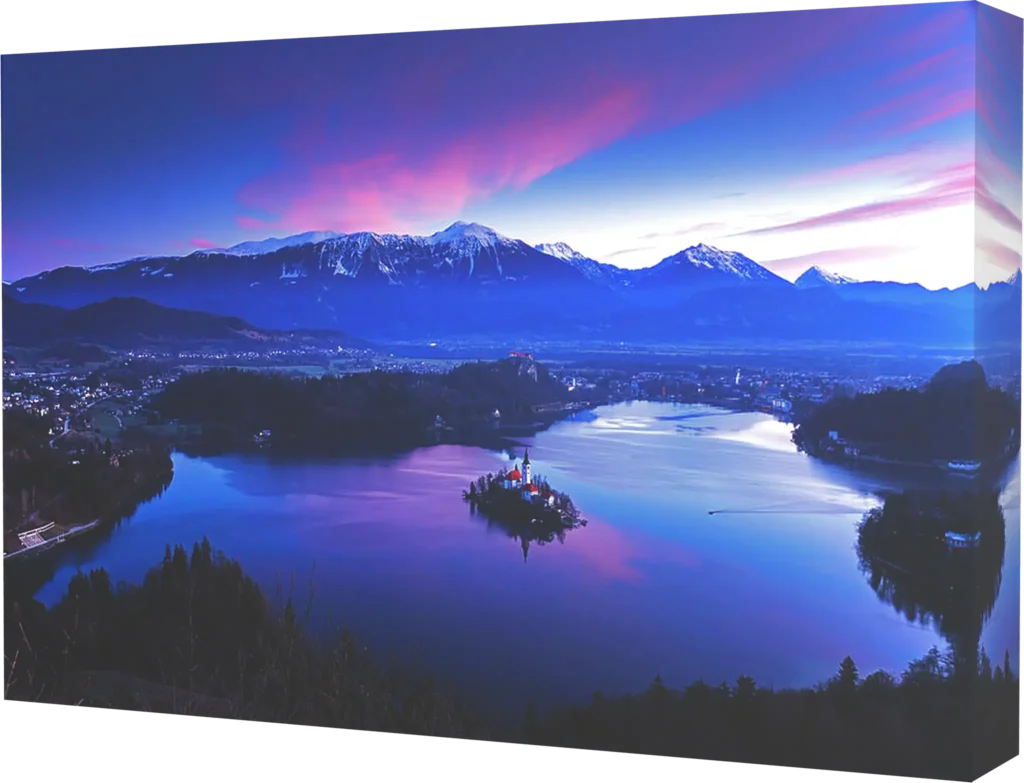
Mock-up: three 90cm Lake Bled canvases in a row above waiting room chairs
Prints across several walls
When a set runs around a room, use the same size of print on every wall and hang them all on the same centre line. Vary the number instead: one print on a short wall, two or three on a long one. Don’t drop to a smaller size just to fit more in, because a mix of sizes breaks the set up. Keep every print the same orientation too; a single upright photo in a row of landscapes looks like a mistake.
How high should you hang pictures in a waiting room?
Above a row of chairs, leave about 20–30cm between the top of the chair backs and the bottom of the prints. Seated people can see them without craning, and nobody leans back into a frame. The usual gallery rule is to put the centre of a picture about 145–150cm from the floor, and in most waiting rooms the two rules end up in roughly the same place.
For a row that reads as one set:
- Hang every print on the same centre line, including prints on different walls.
- Keep the gaps equal: about 10cm between 90cm prints, up to 15cm on a long wall.
- Mark the prints on the wall with masking tape or paper cut to size before you drill. It’s quicker than filling holes.
- Use two fixings per print so it stays level when someone knocks it, and security fixings in rooms that are left unattended.
- Check that the fixings suit your wall. Plasterboard needs the right plugs, especially for 150cm prints.
In corridors, where people walk past rather than sit, hang at the gallery height and space single prints evenly along the wall.
Canvas, framed or metal: which finish suits a clinic?
For most waiting rooms, choose a box canvas or a metal print. Neither has glass that can break if a chair hits the wall. Metal is the easier of the two to wipe clean; canvas should only be dusted.
Paper prints and box canvases are in my shop; every finish is in my Fine Art America store. Cleaning guidance is from Bay Photo’s print care guide. Follow the care notes that come with your print if they differ.
Fine Art America also sells canvas prints with more choices: a glossy or matte surface, 1.5″ or 5/8″ stretcher bars, mirrored, black or white sides, and frames in a range of colours.
Three points that matter more in a clinic than at home:
- Alcohol wipes. Never use alcohol or ammonia cleaners on acrylic, which cloud it over time. Tell whoever cleans the room.
- Glare. Metal and acrylic prints have a high-gloss surface. Hang them where they won’t bounce a window or ceiling light back at the chairs, or choose a matte canvas from Fine Art America.
- Infection control. If your practice policy asks for wipe-clean surfaces on the walls, choose metal. If you frame a paper print, ask your framer for acrylic glazing rather than glass, as it won’t shatter.
How do you order a set of matching prints?
Choose prints from one place, in one finish and one size, and order them together. That keeps the colours consistent across the room, and most sets for a waiting room come to more than £300, which gives you a free shipping option at checkout on my website. If you’re buying several, email me first and I’ll agree a discount.
Choosing prints that match
- One place. Three photos of the same lake or stretch of coast sit together better than three places with different colours of rock and water.
- One time of day. Sunrise prints have warm light; daytime prints are bluer and greener. Keep a wall to one or the other.
- One finish. Don’t mix canvas and metal on the same wall. The surfaces look different side by side.
What a set costs
On orders under £300, delivery is charged as shown on each product page. In the UK that’s £5 for a standard paper print and £15 for a standard canvas; to Europe, the USA, Canada and Australia it’s £15 and £25. EU orders are printed and shipped by Whitewall in Germany.
Ordering through Fine Art America
My Fine Art America store sells the same photos in a much wider range: paper and canvas in more sizes and finishes, plus framed, metal, acrylic and wood prints. It ships worldwide, and every product page on my site links to it.
The free shipping option and my discount codes only work on orders placed through my own website. If you’d like products from Fine Art America with a discount or free shipping, email me with what you want. I’ll set up a private order and have it made and shipped through Fine Art America.
Discounts, VAT and returns
Ordering several prints? Email me at ian@ianmiddletonphotography.com before you order, with the prints and sizes you have in mind. I’ll agree a discount based on the size of the order and send you a coupon code to use at checkout. If you’d like help choosing, send me photos of your walls with rough measurements and I’ll suggest a set.
I’m not VAT registered, so no VAT is added to prices in my shop. For orders through Fine Art America, check its checkout for any tax.
Every print from my shop comes with a 30-day no-quibble money-back guarantee. You pay the return postage; the details are in my refund and returns policy.
Planning a set for your practice?
Send me photos of your walls with rough measurements. I’ll suggest a set and agree a discount.
Which of my prints suit a waiting room?
These are the prints I’d start with. All of them show calm water, open views or flowers, and all are available as paper or canvas from my shop and in other finishes from Fine Art America.
Calm lakes in Slovenia

Sunrise over Lake Bled from Mala Osojnica
The island church and castle at sunrise, from the viewpoint above the lake.

Early spring view across Lake Bled
The same view from Mala Osojnica in early spring.

Summer sun rising behind Lake Bled
Sunrise over the Karavanke mountains.
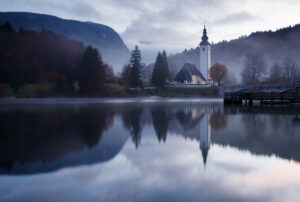
Church of Saint John at sunrise
Morning mist and cloud over Lake Bohinj.
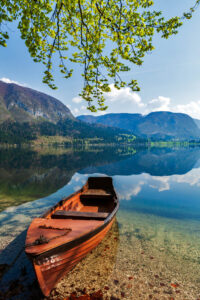
Kayak on Lake Bohinj
People at leisure on the lake. The Lake Bohinj gallery has more, including sailing boats.
Quiet coast in England
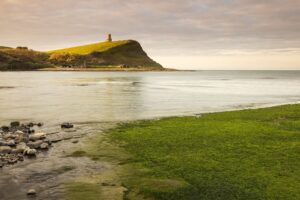
Morning at Kimmeridge Bay
On the Jurassic Coast in Dorset.
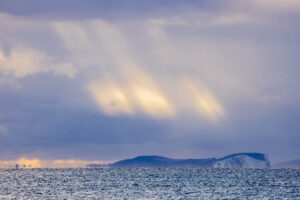
Morning light over the Isle of Wight
Seen from Swanage seafront.
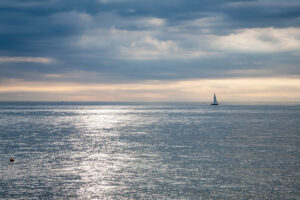
Sailing the Calm Sea
Light breaking through the clouds as a sailing boat passes at Kingsdown, Kent.
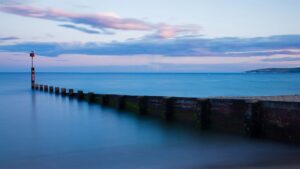
Seascapes gallery
Pick the still mornings and leave the crashing waves.
Flowers

Lavender fields at Hartley Park Farm
Near Alton in Hampshire. Rows of lavender with old trees behind.
Panoramas for reception
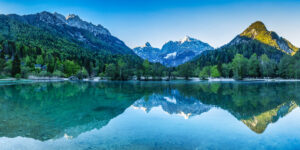
Lake Jasna in spring
Near Kranjska Gora, with the Julian Alps behind.
Kamnik Alps panorama
Stitched from seven photos.
Panoramas gallery
More wide views for long walls.
My own pick
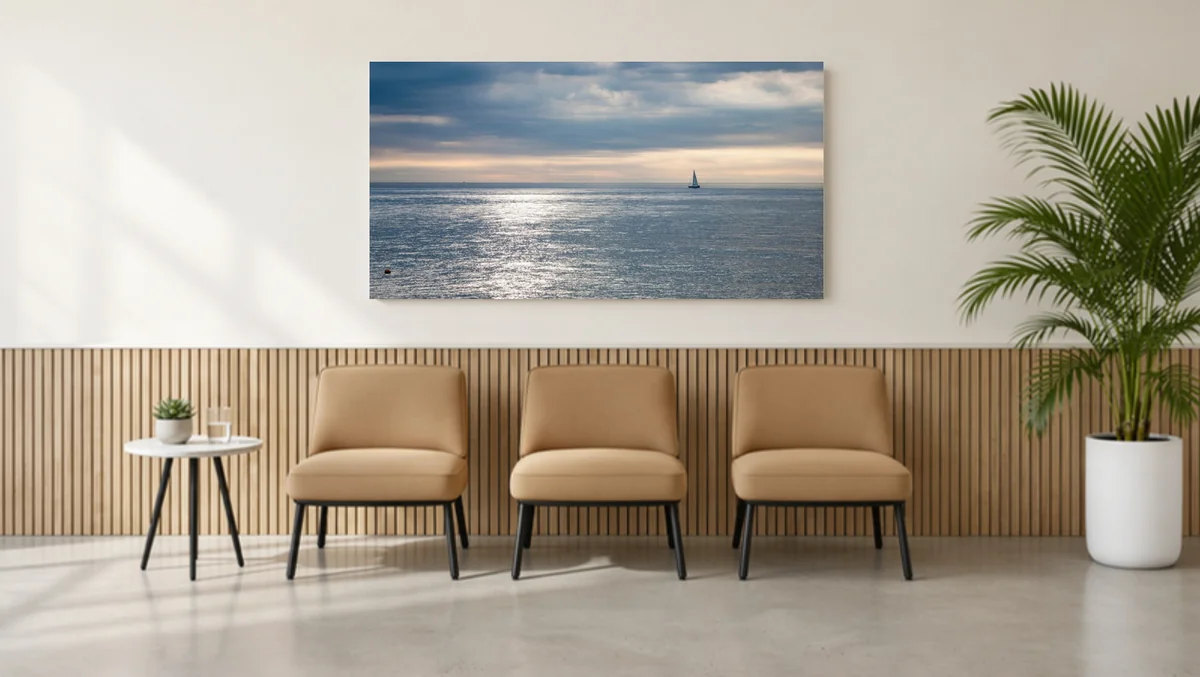
Sailing the Calm Sea, Kingsdown, Kent
If I could hang only one print in a waiting room, it would be Sailing the Calm Sea. Light breaks through the clouds as a sailing boat passes on an otherwise empty sea at Kingsdown in Kent. It’s the colour version of one of my favourite black and white photos, and the one I find most calming.
Browse every print in the shop, or start with the Lake Bled gallery and the waterscapes gallery.
Frequently asked questions
What is the best art for a dental waiting room?
Calm landscapes work best in a dental waiting room: still water, mist, sunrise and open views with distance in them. Hospital art guidelines based on Roger Ulrich’s research recommend these subjects, and one study found dental patients had lower heart rates on days a landscape mural hung in the waiting room.
What size should pictures be in a waiting room?
Start with 90cm prints for the main wall, because people see them from 3–4 metres away. A row of prints, including the gaps, should cover about two-thirds to three-quarters of the wall or the seats beneath it. Three 90cm prints 10cm apart, 2.9m in total, suit a 4m wall.
How high should art hang above waiting room chairs?
Leave about 20–30cm between the top of the chair backs and the bottom of the prints. That keeps them in view for seated people and stops anyone leaning back into a frame. Hang every print in a set on the same centre line, even across different walls.
Is canvas or metal better for a clinic?
Both work, because neither has glass that can break. Metal prints are easier to keep clean: wipe them with a soft cloth and water or a non-ammonia glass cleaner. Canvas should only be dusted. Never use alcohol wipes on acrylic prints, as alcohol clouds the surface.
Can I get a discount on a set of prints?
Yes. Email me before you order with the prints and sizes you want, and I’ll agree a discount based on the size of the order and send a coupon code for checkout. Choose one place, one size and one finish so the colours match. Orders over £300 on my website also get a free shipping option.
Sources
- UConn Health, Connecticut Collection artwork guidelines, citing Ulrich and Gilpin, Healing Arts (2003)
- Law et al., Viewing Landscapes Is More Stimulating Than Scrambled Images After a Stressor, Frontiers in Psychology (2020), which reports Heerwagen’s 1990 dental waiting room study
- Stress-reducing effects of real and artificial nature in a hospital waiting room, PubMed abstract
- Bay Photo, print care guide
Ian Middleton
Landscape and travel photographer and co-author of Mysterious World: Ireland. My original photographs are available as fine art prints.