
Halloween began in Ireland as Samhain (pronounced SOW-in), the Gaelic festival that closed the old year and opened the new one on the night of 31 October. On that night, the Celts believed, the doors between our world and the Otherworld opened, and the Tuatha Dé Danann, the magical race who ruled Ireland before them, came out of their fairy mounds.
Trick or treating and dressing up both grew out of that belief. And much of the belief leads back to one green hill in County Westmeath: the Hill of Uisneach, where Ireland got its name and where two of the Tuatha Dé Danann are said to be buried.
I first came to Uisneach in 2004, while researching Mysterious World: Ireland, the guide to Ireland’s ancient sites and legends I co-wrote with Douglas Elwell. I went back in May 2013 to take the photos in this article.
What is Samhain?
Samhain is the Gaelic festival that marked the end of the harvest and the start of winter, held from sunset on 31 October to sunset on 1 November. The name is often translated as “summer’s end”, and the Irish for Halloween is still Oíche Shamhna, Samhain night.
Samhain is widely described as the Celtic new year. The night of 31 October was the last night of the old year, which makes Halloween, in effect, Celtic New Year’s Eve. With the harvest stored, people gathered for feasts that could run for several days.
The Christian church later placed All Saints’ Day, or All Hallows, on 1 November. The night before became All Hallows’ Eve, later shortened to Halloween.
Halloween is often taken for an American import. It isn’t: Irish emigrants took Samhain customs across the Atlantic, and America made them bigger. I’ve told that part of the story in why Halloween isn’t American.
What were the four Celtic festivals of Ireland?
The Gaelic year turned on four festivals: Samhain, Imbolc, Bealtaine and Lughnasa. Each fell roughly halfway between a solstice and an equinox, and Samhain opened the year.
Samhain
Bealtaine
Lughnasa
1 August
Samhain and Bealtaine were both fire festivals. The 17th-century historian Geoffrey Keating wrote that on Samhain eve every fire in Ireland was put out and relit from a fire on the Hill of Tlachtga, now the Hill of Ward near Athboy, County Meath. Archaeologists from University College Dublin found evidence of intense burning there in 2014.
Six months later, at Bealtaine, the fire was lit on the Hill of Uisneach. It was said to be visible across Ireland and was the signal for fires to be lit around the country.
Who were the Tuatha Dé Danann?
The Tuatha Dé Danann were a race of gods and magicians who, in Irish legend, ruled Ireland before the Celts. The name is usually translated as “the people of the goddess Danu”. Monks recorded their story in the 11th-century Book of Invasions (Lebor Gabála Érenn), which lists them as the fifth group to take Ireland.
They brought treasures with them, including the Lia Fáil, the Stone of Destiny that still stands on the Hill of Tara. Their gods included the Dagda, who is said to have lived on Uisneach, Lugh of the Long Arm, Brigid and Ériu.
When the Milesians, the Celtic ancestors of the Irish, arrived and defeated them, the land was split in two. The Milesians took the world above ground. The Tuatha Dé Danann went beneath it, into the sídhe: the fairy mounds and ancient burial cairns found all over Ireland.
Over the centuries they became the aos sí, the fairy folk. That’s why farmers leave a lone hawthorn standing in the middle of a field, why the banshee (bean sí, “woman of the fairy mound”) wails before a death, and why Samhain mattered so much: it was the one night of the year when the mounds opened.
Why is the Hill of Uisneach a gateway to the Otherworld?
The Hill of Uisneach in County Westmeath was the sacred centre of ancient Ireland: the place where the five provinces met, where Ireland got its name, and one of the doorways to the Otherworld that the Tuatha Dé Danann now inhabit. It lies off the R390 between Mullingar and Athlone, near the village of Killare.
At 180 metres it’s hardly a mountain, but up to twenty counties are visible from the summit on a clear day. Around twenty monuments survive on the hill, from a probable Neolithic tomb on the summit to the ringfort known as the Palace.
Uisneach, 2004
My first visit didn’t go to plan. A brown sign in a lay-by on the R390 seemed to point at the hill beside the road, so I headed up it. An hour later, after climbing fences and dodging sheep and cows, I came out above the lay-by. From there I spotted a pile of rocks behind a tree, on the hill across the road. I’d spent the hour on the wrong hill.
Back down by the van I looked for a way up, but every gate said entry was prohibited. I drove a little way up the road and stopped at the Uisneach Inn in Killare for a drink and some local information.
‘What do you know about the Hill of Uisneach?’ I asked the barman.
‘Not a lot,’ he replied.
Many people might think that asking locals is the best thing to do, but in most cases people don’t take much notice of what is around them. They just take it for granted.
‘Well, do you know how I can get up there?’
‘The only way is over the fields,’ he said.
‘But all the signs on the gates say you cannot enter.’
‘Ah, don’t worry, the landowner just puts that there for insurance purposes, so if you do go in you do so at your own risk. He doesn’t mind if you do go up there.’
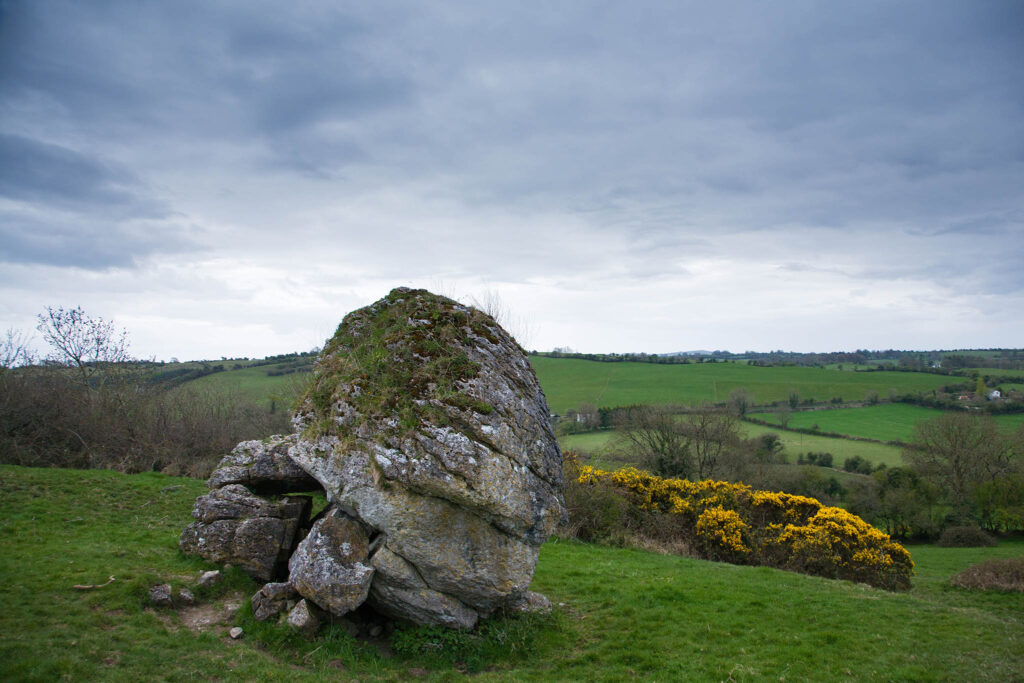
I finished my drink, drove back to the lay-by and found a way up. By the time I sat down beside the Catstone, I was very tired.
When I went back in May 2013 to take these photos, the sign had a mobile number on it. I rang the landowner for permission. He was very helpful, gave me clear directions to the stone, and later came out to see me while I was there. It was a typical cloudy Irish day, but thankfully not raining. Poor lighting never ruins photos of Ireland’s mystical, ancient places. They seem to exude a magic all to themselves.
You can’t wander up on your own any more. The hill is now only open on guided tours, which start from the visitor centre.
Ériu and the Stone of the Divisions
On the south-west slope sits Ail na Míreann, the Stone of the Divisions. It’s a limestone boulder almost 6 metres tall and over 30 tons, left by the ice at the end of the last Ice Age and split into several pieces. Locally it’s called the Catstone, because from the right angle it looks like a cat watching a mouse.
The cracks are said to represent the ancient divisions of Ireland, and this is where the five provinces met: Ulster, Munster, Leinster, Connacht and Mide (Meath), the royal province at the centre. The Irish word for a province, cúige, means “a fifth”, even though there are only four today.
Legend says the stone is also the grave of Ériu, a queen of the Tuatha Dé Danann. She led the Tuatha Dé Danann in their first battle against the Milesians and was mortally wounded, and as she lay dying she asked Amergin, the Milesians’ chief poet, for two things: to be buried beneath the stone, and for the island to carry her name forever. Amergin agreed.
Ériu became Éire, the Irish name for Ireland, and Norse and English speakers added “land” to make Ireland. Her sisters Banba and Fódla made the same request, and their names survive as poetic names for the country.
Folklore also calls the stone the gateway to the fifth province, Mide, which in some tellings lies in the Otherworld itself. Ireland’s name, its provinces and a door to the land of the Tuatha Dé Danann all meet at this one boulder.
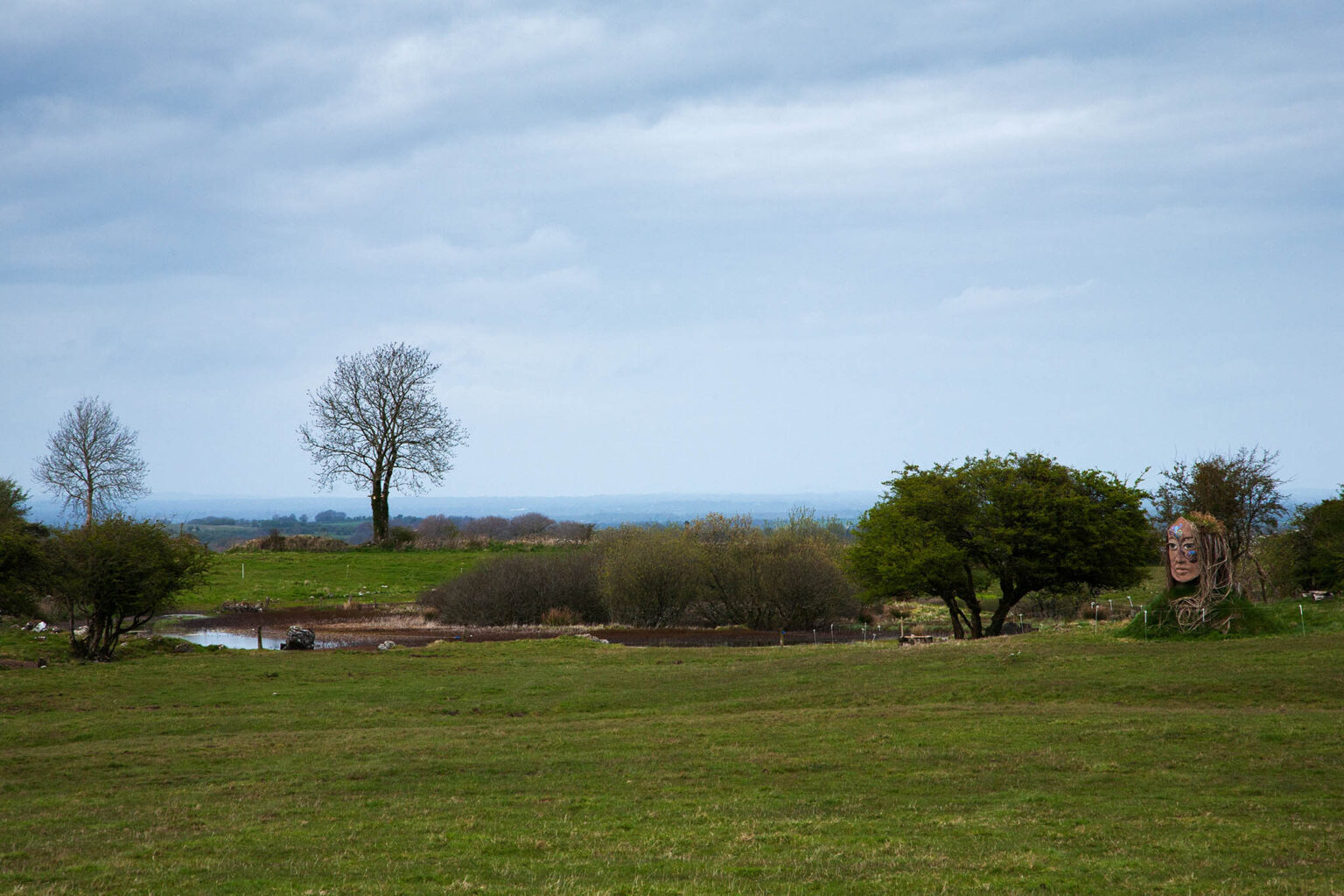
Lough Lugh: where the god Lugh drowned
About 300 metres east of the summit is Lough Lugh, a small lake around a central earthwork. Legend names it as the spot where Lugh of the Long Arm died.
Lugh was the warrior king of the Tuatha Dé Danann who defeated the Fomorians and killed their leader, Balor of the Evil Eye. He later killed Cermait, a son of the Dagda, over an affair with Lugh’s wife. Cermait’s three sons, Mac Cuill, Mac Cecht and Mac Gréine, came to Uisneach for revenge. Mac Cuill speared Lugh in the foot, Lugh escaped to the lake, and there they drowned him. A nearby mound, Carn Lugdach, is said to be his grave.
Mac Gréine was Ériu’s husband, so the hill’s two best-known legends belong to the same family. Lugh’s name lives on in Lughnasa, the August harvest festival. The lake itself was dug out in late prehistory to keep it as open water, which suggests it was used for ritual.
I photographed Lough Lugh on the same cloudy day in May 2013.
Why is Samhain the night the Otherworld opens?
Samhain sat between the old year and the new, so it belonged to neither, and on that night the boundary between the living world and the Otherworld wore thin. The doors of the sídhe opened, the aos sí came out to roam, and the souls of the dead could return to their homes.
Those doors were real places in the landscape: fairy mounds, passage tombs, lone hawthorns like the fairy tree on the Hill of Tara, and hills like Uisneach. Bealtaine, six months later, was the other night when the boundary thinned, and both were marked with fires on hilltops.
People left food out for the aos sí and stayed away from the mounds after dark. Stories warned that anyone who wandered too close to one on Samhain night might not come back.
Who was Aillén, the goblin who burned Tara every Samhain?
Aillén mac Midgna, sometimes written Aileen, was a fire-breathing goblin of the Tuatha Dé Danann. According to the medieval tale The Boyhood Deeds of Fionn, he burned the Hill of Tara to the ground every Samhain for 23 years, which earned him the nickname “the Burner”.
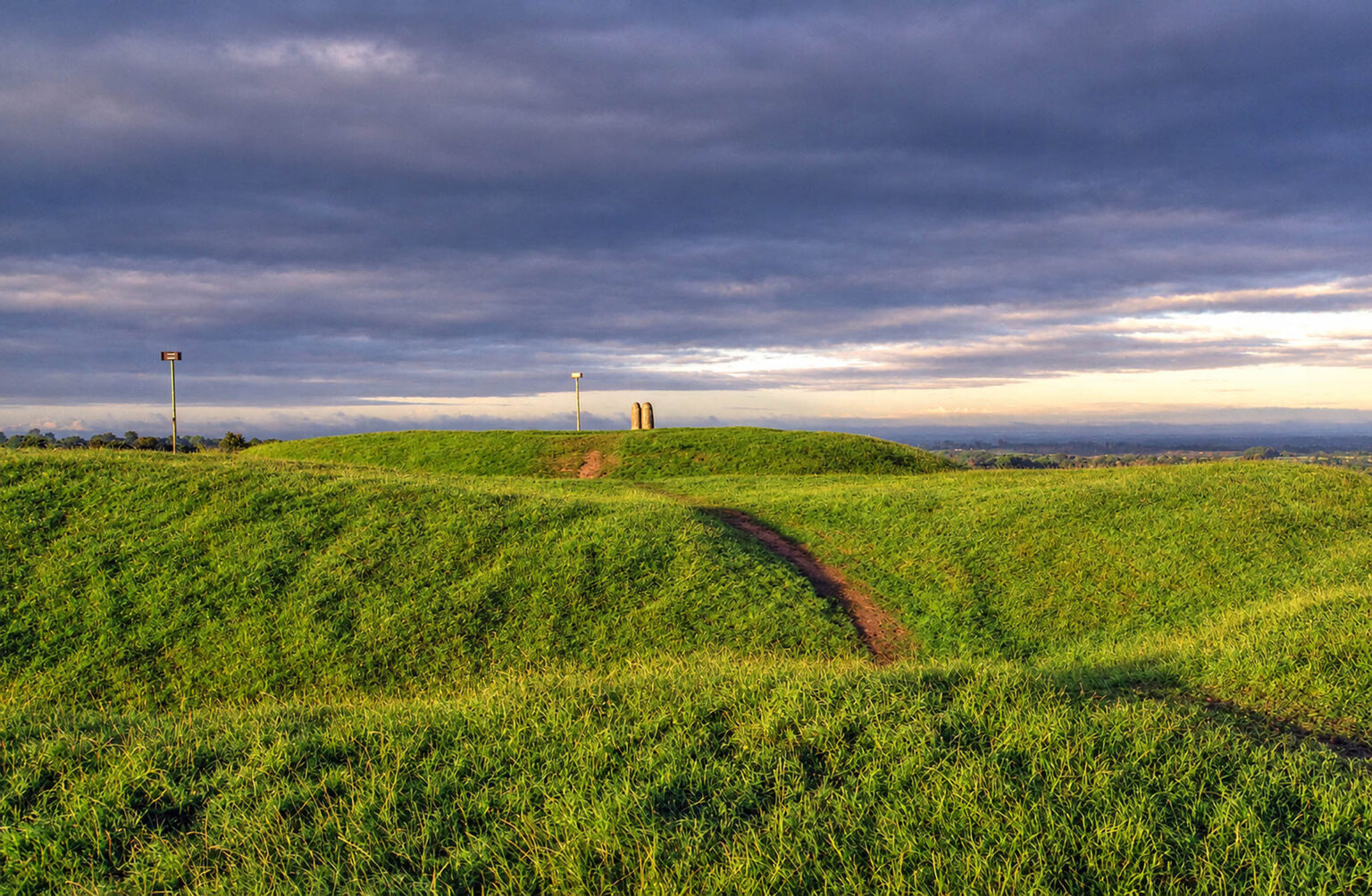
An ancient road ran from Uisneach to Tara in County Meath, the seat of the High Kings. Every Samhain the High King held a feast there, the Feis Temro. And every Samhain, Aillén came out of his fairy mound with a harp. He played music so sweet that every warrior at Tara fell asleep, then breathed fire over the royal halls and burned them down. Each year they were rebuilt, and each year he came back.
That ended when a young Fionn mac Cumhaill (Finn McCool) offered to guard Tara through Samhain night. In return he asked for his father’s old place as leader of the Fianna, the High King’s warriors. An old comrade of his father, Fiacha mac Congha, gave him a spear tipped with poison. When the music started, Fionn pressed the spearhead to his forehead and breathed in its fumes, and they kept him awake.
Aillén breathed his fire and turned to flee back to his mound. Fionn caught him before he reached it and killed him with the spear. The High King kept his word, and Fionn became leader of the Fianna.
Tara is tied to Samhain in stone as well as story. The Mound of the Hostages, a passage tomb on the hill, is thought to line up with the sunrise around Samhain.
When I visited Tara I put my hand on the Lia Fáil, the stone said to roar when the true High King touches it. There was no sound, so I crossed High King of Ireland off my list of potential destinies.
Where does trick or treating come from?
Trick or treating grew out of Samhain customs in Ireland and Scotland. On the night the aos sí roamed, people left food and drink out to keep them friendly. Anyone who had offended the fairies during the year, by cutting down a fairy tree for instance, could expect a trick, and a treat left on the step bought them off.
In time, people began playing the part of the spirits themselves. In guising, recorded in Ireland and Scotland since at least the 16th century, people went from house to house in disguise and performed a verse or a song in return for food. Nineteenth-century accounts describe guisers warning of bad luck if they were turned away: the trick behind the treat.
Irish and Scottish emigrants took guising across the Atlantic. The first record of it in North America comes from Ontario, Canada, in 1911, and the words “trick or treat” appear in Canadian newspapers within a few years. In Ireland, children at the door said “help the Halloween party” instead, and “trick or treat” only became common there in the 2000s.
Why do we dress up at Halloween?
People dressed up at Samhain so the spirits abroad that night wouldn’t recognise them, or would take them for one of their own.
The guisers carried the custom on, and in Ireland and Scotland Halloween masks are still called “false faces”. Bonfires on the hills kept the darker spirits at a distance, and carved lanterns did the same job on the doorstep. In Ireland those lanterns were cut from turnips long before anyone used a pumpkin.
A child in a skeleton suit on 31 October is doing much the same as a guiser on Samhain night: staying in disguise until the doors to the Otherworld close at sunset the next day.
Can you visit the Hill of Uisneach at Samhain?
Yes. Uisneach holds a two-day Samhain gathering, An Tairseach: Samhain ar Uisneach. Details and tickets are on the Uisneach events page.
An Tairseach: Samhain ar Uisneach 2026
The rest of the year you can only go up the hill on a guided tour, because it’s private land on a working farm.
Saturdays and Sundays at 11:00 all year, plus Friday sunset tours at 18:00 from May to September. All places must be booked in advance.
Tour times and prices checked in October 2026 on the Uisneach tours page.
The Hill of Tara lies just off the M3 between Dublin and Navan, and you can walk the hill without booking. My Hill of Tara guide covers the Lia Fáil, the Mound of the Hostages and the fairy tree, and my Hill of Uisneach article has more on the hill’s other monuments.
Prints of Uisneach and Tara
The three photos in this article are available as fine art prints from my shop:
The Stone of the Divisions
Hill of Uisneach. The split Catstone, said to be the grave of Ériu.
Purchase »
Lough Lugh
Hill of Uisneach. The small lake where legend says Lugh was drowned.
Purchase »

The Royal Seat
Hill of Tara. The Iron Age rath, with the Lia Fáil on the mound.
Purchase »
Giclée printed with archival inks on fine art paper, with a 1″ white border.
30cm
£35
£65
£110
£200
£65
£120
£220
£395
I ship from my site to the UK, Europe, the USA, Canada and Australia, and every print has a 30-day money-back guarantee. Framed, metal and acrylic prints, and delivery to other countries, are available through my Fine Art America store, linked from each print page.
Ireland's beautiful scenery, for the wall
Uisneach and Tara prints. Paper, canvas, metal, acrylic and more.
Samhain FAQ
How do you pronounce Samhain?
Samhain is pronounced SOW-in, with “sow” rhyming with “cow”. In Irish the “mh” is spoken as a soft “w” or “v” sound, which is why the word looks nothing like it sounds. The Irish name for Halloween night, Oíche Shamhna, is pronounced roughly EE-ha HOW-na.
When is Samhain celebrated?
Samhain runs from sunset on 31 October to sunset on 1 November. It was one of the four Gaelic seasonal festivals, marking the end of the harvest and the start of winter, and is widely described as the Celtic new year. Some modern Samhain gatherings, including the one on the Hill of Uisneach, are held in early November.
Where was Samhain celebrated in ancient Ireland?
The two places most linked to Samhain are both in County Meath. On the Hill of Tlachtga, now the Hill of Ward near Athboy, a fire was lit on Samhain eve and every fire in Ireland was relit from it. On the Hill of Tara, the High King held the Samhain feast, the Feis Temro.
Did trick or treating start in Ireland?
Trick or treating grew out of guising, a custom recorded in Ireland and Scotland since at least the 16th century. Guisers went door to door in disguise, performing a verse or song for food, and sometimes warned of bad luck if they were refused. Irish and Scottish emigrants took the custom to North America, where it became trick or treating.
Why is the Hill of Uisneach linked to the Otherworld?
The Hill of Uisneach in County Westmeath was the sacred centre of ancient Ireland. Its Stone of the Divisions, where the five provinces met, is said to be the grave of Ériu, the Tuatha Dé Danann queen who gave Ireland its name. Folklore calls the stone the gateway to the fifth province, Mide, and to the Otherworld.

Ian Middleton
Landscape and travel photographer and co-author of Mysterious World: Ireland. My original photographs are available as fine art prints.


